
Uzbekistan airports post 15.5% passenger growth in H1 2026
Double-digit gains recorded across domestic and international networks
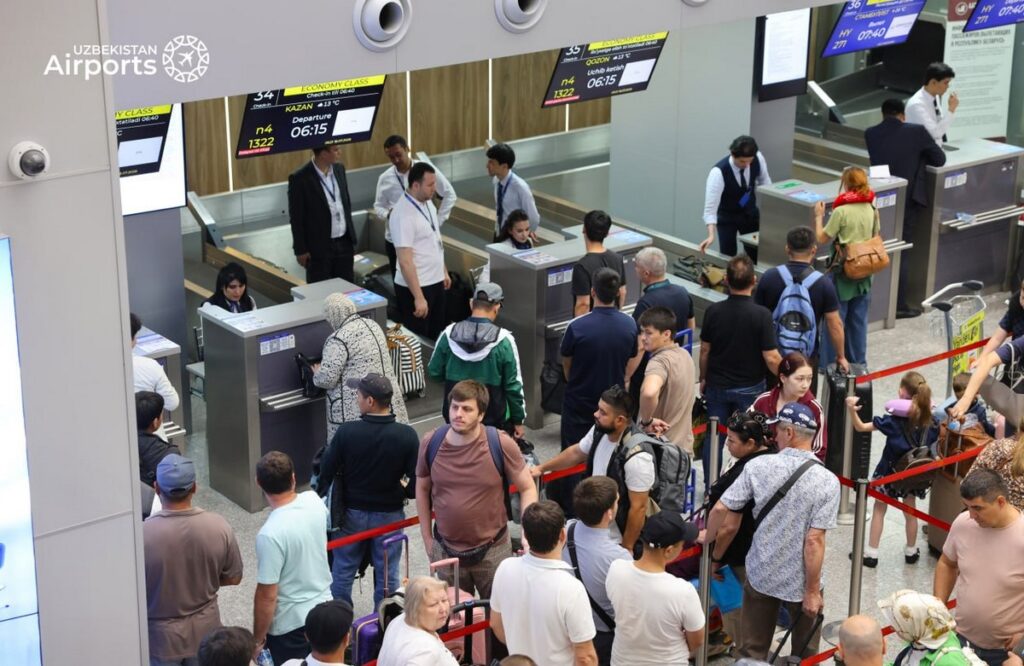

Despite broader geopolitical headwinds, Uzbekistan’s airport network sustained its growth momentum through the first half of 2026, delivering robust operational gains across most key metrics.
Data released by state operator Uzbekistan Airports shows that Central Asian nation’s gateways collectively handled 8.153 million passengers between January and June, up 15.5% year-on-year. International traffic rose to 6.698 million passengers (+15.4%), while domestic demand grew to 1.455 million (+16.2%).
Air cargo and mail volumes expanded rapidly—surging 33% to reach 51,550 metric tons. Total aircraft movements increased 8.1% year-on-year to 64,830. International flights drove the operational uptick with 47,370 movements (+11.7%), whereas domestic flight movements contracted slightly to 17,460 (-0.5%).
Tashkent International Airport maintained its dominant market position, handling 5.364 million passengers (+17%) and widening its lead over second-place Samarkand (+7.2%). The capital gateway now commands over 65% of national passenger traffic and roughly 62% of all flight operations. Tashkent recorded 40,280 aircraft movements (+7%) and processed 48,170 tons of cargo (+33.2%), representing approximately 93% of the country’s total air freight. This performance was underpinned by aggressive network expansion, with new foreign carriers entering the market during H1—including China Eastern (Shanghai), Asiana Airlines (Seoul), and Shirak Avia (Yerevan)—alongside local airlines adding routes and boosting frequencies.
Among regional gateways, Andijan Airport delivered the most dramatic traffic surge (+2249%). This spike follows the facility’s reopening on March 20, 2025, after a major airfield overhaul capable of accommodating widebody aircraft. The triple-digit growth rate largely reflects a low base effect.
Solid passenger gains were also posted at Termez (+52%), Urgench (+24%), and Nukus (+23%), driven by a combination of new international routes and enhanced domestic connectivity to meet peak seasonal tourist demand.
Conversely, operational pullbacks were noted across several regional hubs. Fergana saw flight operations drop by 11%, Namangan passenger traffic declined by 11%, and Bukhara recorded a 4% dip in movements. The steepest drops occurred at Karshi (passengers -22%, flights -6%) and Navoi (passengers -27%). Uzbekistan Airports attributed these regional declines to ongoing airline route realignments, shifting demand dynamics, and geopolitical pressures prompting schedule revisions across the region.
UZBEKISTAN AIRPORTS: KEY PERFORMANCE HIGHLIGHTS FOR THE FIRST HALF OF 2026
| Airport | Pax Traffic | Pax YoY | Int’l Pax | Domestic Pax | Total Flights | Flights YoY | Int’l Flights | Domestic Flights |
|---|---|---|---|---|---|---|---|---|
| Tashkent | 5,364,282 | +17% | 4,645,615 | 718,667 | 40,283 | +7% | 32,044 | 8,239 |
| Samarkand | 759,232 | +7% | 720,854 | 38,378 | 5,902 | +3% | 5,242 | 660 |
| Urgench | 479,527 | +24% | 250,565 | 228,962 | 3,566 | +21% | 1,799 | 1,767 |
| Namangan | 338,736 | -11% | 313,661 | 25,075 | 2,715 | +4% | 2,050 | 665 |
| Fergana | 325,804 | +2% | 47,928 | 277,876 | 2,628 | -11% | 1,633 | 995 |
| Bukhara | 273,977 | +5% | 167,400 | 106,577 | 2,614 | -4% | 1,246 | 1,368 |
| Termez | 225,146 | +52% | 127,848 | 97,298 | 2,236 | +24% | 839 | 1,397 |
| Nukus | 180,703 | +23% | 54,114 | 126,589 | 1,455 | +9% | 399 | 1,056 |
| Andijan | 117,019 | +2249% | 85,494 | 31,526 | 916 | +835% | 579 | 337 |
| Karshi | 71,033 | -22% | 46,774 | 24,259 | 989 | -6% | 306 | 683 |
| Navoi | 18,011 | -27% | 8,158 | 9,853 | 1,527 | +28% | 1,234 | 293 |
Source: Uzbekistan Airports
Don't miss our articles — subscribe
Key commercial aviation news from Central Asia and the South Caucasus — once a week, in your inbox.

Editor’s Choice
-
Uzbekistan’s airports set new record with 15.5 million passengers in 2025
AirportsNews -
LCC Pobeda launches three new routes to Uzbekistan from Moscow
AirlinesAirportsNews -
flydubai Cargo and SolitAir expand Central Asian freight operations
AirlinesAirportsCargoNews -
China–EU Multimodal Cargo Corridor Opens via Tashkent
AirlinesAirportsCargoNews
Editor’s Choice
-
Uzbekistan’s airports set new record with 15.5 million passengers in 2025
AirportsNews -
LCC Pobeda launches three new routes to Uzbekistan from Moscow
AirlinesAirportsNews -
flydubai Cargo and SolitAir expand Central Asian freight operations
AirlinesAirportsCargoNews -
China–EU Multimodal Cargo Corridor Opens via Tashkent
AirlinesAirportsCargoNews