
Kazakhstan’s air transport market: Three players and the capacity surplus window
Aviation expert Kirill Vlasov assesses Central Asia's largest air transport market in the first part of his analysis for CentralAsia+Aero


When Air Astana, Kazakhstan’s leading airlines group, disclosed its first quarter results of 2026 in early May, the press release and the financial numbers told two different stories. Revenue increased by 13.2% to USD 331 million. Transfer passenger traffic rose by 65%, and RASK by 12.4%. But the net loss for the quarter reached US$21.1 million, EBITDAR fell by 19.6%, and CASK increased by 19.8%. It was this gap between revenue and cost that shaped the rest of the financial picture.
This is the Kazakh air transport market in its current phase. Demand is there, networks are being reshaped quickly, and transit traffic is coming in waves. But the economics of the country’s largest carrier are entering territory in which it has rarely operated before. During the pandemic, there was an external shock and a relatively clear exit scenario. The pressure now is different: not one crisis, but several parallel constraints, each eating into margin.
The market itself remains large and growing. In 2025, Kazakhstan’s airports handled 31.8 million passengers, up 7.1%. It is the largest aviation market in Central Asia, and the average annual growth rate over the past three years exceeds 10%. Geography is the key asset: almost half of the world’s population lives within a seven-hour flight radius, and that radius can be served by standard narrow-body aircraft.
But geography does not turn into profit by itself. The entry barrier is lower than in long-haul markets, but there are domestic constraints of its own: airports, ground handling, personnel, distribution, currency, access to bases, and fleet cost. The paradox is therefore clear: the market is growing, the state is stimulating competition, and yet the leading player is starting to lose money. To understand why, the nation’s three major carriers need to be considered separately.
AIR ASTANA: THE NEW NORMAL, WITH A MINUS SIGN
Air Astana Group means full-service flag carrier Air Astana and LCC FlyArystan: 9.7 million passengers in 2025, some 65% of the market, 67 aircraft, and a plan to grow fleet to 86 aircraft by 2030. In March 2026, BAE Systems sold its remaining GDR stake and fully exited the capital.
According to Kazakhstan Stock Exchange (KASE) disclosure as of 1 April 2026, the Sovereign Wealth Fund Samruk-Kazyna retains 41.18%, while 37.68% is held through Citibank N.A.-NY as GDR depositary. The state remains the anchor shareholder, but the group no longer has an international industrial shareholder.
Peter Foster, who had led the company since 2005, handed over management to Ibrahim Canliel on 1 April 2026. The new Chief Financial Officer is Gonçalo Pires, former CFO of TAP Air Portugal. The appointment is telling: the group now needs not only growth, but control over costs, lease burden, cash flow and earnings quality.
The group’s main technical challenge is the Pratt & Whitney PW1100G engines which power the A320neo family fleet. In 2025, the group recorded 22 unscheduled engine removals; at the seasonal peak, up to 13 aircraft were grounded at the same time, and the EBITDAR impact reached USD 42.3 million. In the first quarter of 2026, Air Astana additionally purchased and leased six spare engines. That helps protect the schedule, but it immediately raises cost.
The second blow is the Middle East conflict. Dubai, Doha, Jeddah and Medina are among the network’s highest-yielding routes: business traffic, religious travel, and strong load factors. Following the renewed escalation around Iran, airspace restrictions in the region returned in May. For Air Astana, this means the loss of a high-margin part of the network while fixed fleet and personnel costs remain in place.
The long-haul fleet plan is also becoming more complex. Air Astana has an order for up to 15 Boeing 787-9s in addition to three Dreamliners expected in 2026/27; total 787 commitments could take the fleet to as many as 18 wide-body aircraft. Singapore, Seoul and Bangkok are logical candidates for reinforcement, but entry into the United States remains a separate challenge. The issue is not only aircraft availability, but also routing, airspace and long-sector economics.
The reaction of the new management is revealing. On the first-quarter results call, Canliel described the situation as a “new normal” and stressed that the fleet had been redeployed from the Gulf within 48 hours. Shanghai was launched in March; Guangzhou from Astana has been announced from 2 June; frequencies to China are expected to grow. Transit traffic increased by 65%, as passengers looked for alternative routings outside the Middle East. The logic is sound, but it solves revenue, not margin: the EBITDAR margin for the quarter fell from 20.5% to 14.6%.
SCAT: QUIET PRIVATE EXPANSION
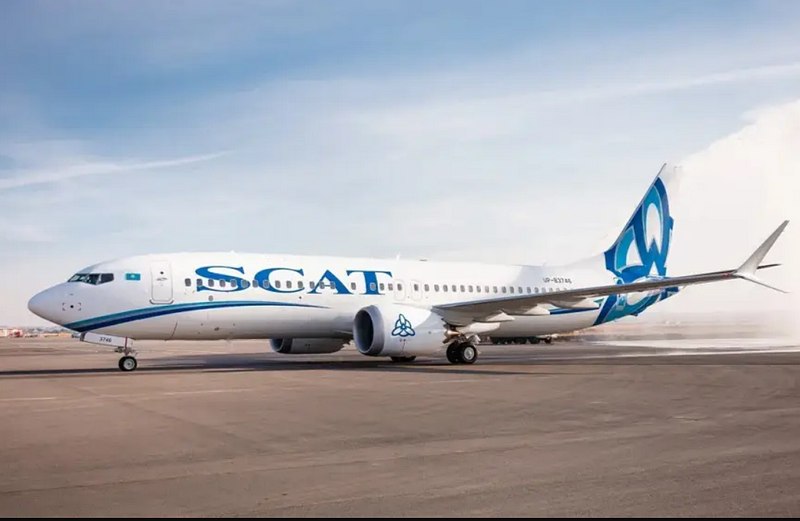
SCAT Airlines is the second largest major market player: roughly 3.5–4 million passengers in 2025, a market share of 22–25%, and a fleet of 34 aircraft. It is a private company built around Shymkent as its base logic. SCAT is the only Boeing 737MAX operator in Central Asia. In late April 2026, Boeing and SCAT announced another new order for five Boeing 737MAX-9s; previously announced MAX deliveries for 2027–2028 also remain in place.
Strategically, SCAT occupies a niche that the other players have not yet replicated: Shymkent as a southern international gateway. Prague, Budapest, Munich, Belgrade, Tbilisi and Riga form its European network; Xi’an, Shanghai, Urumqi, Seoul and Bangkok represent the Asian direction. In December 2024, SCAT opened and manages Terminal A in Shymkent with annual capacity of 6 million passengers; in February 2026, together with Boeing, it began construction of an MRO center for the B737 family at the airport.
This is an important shift. If the SCAT/Boeing project is implemented, Shymkent will gain not only a passenger hub, but also an engineering center of gravity. A local B737 maintenance base could become a competitive advantage in its own right, not merely supporting infrastructure.
Management openly admits that the current fleet is insufficient for both international expansion and socially essential domestic routes. The latter are operated through the subsidiary South Sky utilizing An-24 turboprop aircraft. New regional routes have been announced for May and June, and the network is growing without a major public campaign. This is perhaps the main stylistic difference between SCAT and Air Astana: less presentation, more quiet asset accumulation. The weakness of the model is opacity: SCAT’s financial statements are not public, making it difficult for an external observer to assess real margins.
VIETJET QAZAQSTAN: A BET IN PROGRESS
The former Qazaq Air failed to achieve sustainable profitability over ten years since inception, accumulating around KZT 38 billion in debt with a fleet of five Dash 8-Q400 turboprop aircraft.
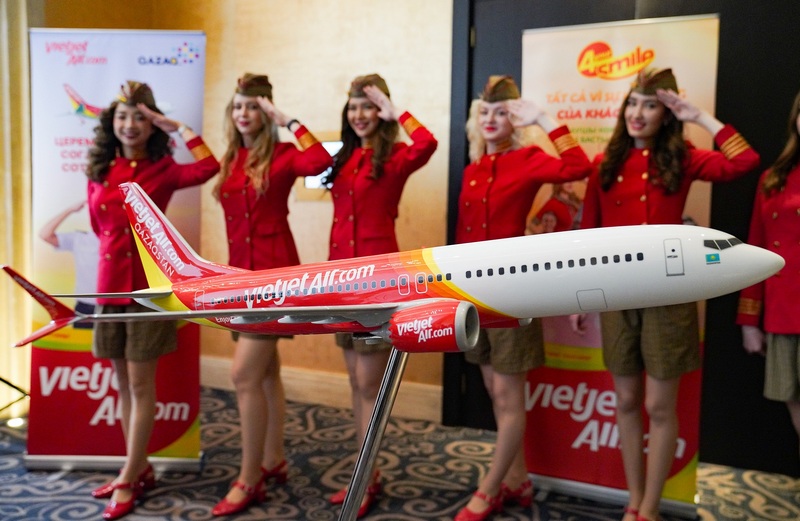
In May 2025, Samruk-Kazyna sold 51% of Qazaq Air for KZT 1.02 billion: 49% went to Vietnam’s Central Asia Aviation Holdings, linked to Sovico Group and LCC Vietjet, while another 2% went to Kazasia Holdings in the Astana International Financial Center jurisdiction. The transaction also included obligations related to Qazaq Air’s KZT 38 billion debt.
The investor’s key commitment is the delivery of at least 20 Boeing 737MAX jets over five years. The first MAX is expected in September 2026. Qazaq Air/Vietjet Qazaqstan’s on-time performance improved over the year from 75% to 87%, high load factor remains around 89%, and passenger traffic is growing. Pilot recruitment is under way with transition to the MAX, including openings for foreign candidates. For the Kazakh market, this is a new signal: the crew base is becoming regional, not purely national.
For the time being, the business model focuses on domestic routes out of the capital, Astana, with a handful of international flights: Samarkand, Uzbekistan, Bishkek, Kyrgyzstan, Omsk and Novosibirsk in Russia. Leveraging fifth-freedom rights, parent airline Vietjet Air has announced a Hanoi–Almaty–Prague route launching this July.
According to industry sources, Sovico is also studying the purchase or trust management of one Kazakh airport; Aktau appears the most logical candidate.
FOREIGN CARRIERS AND THE LOGIC OF OPEN SKIES
Around 356 weekly flights are operated from Almaty, Kazakhstan’s largest city, and around 177 from Astana.
The most competitive corridors are Turkey, Uzbekistan and Russia. India is growing quickly. China is gaining a separate impulse: the memorandum with China provides for up to 124 weekly flights and fifth-freedom rights. Asiana has moved to daily Seoul service, LOT has announced Warsaw, Eastar Jet has announced Busan, and Armenia’s Shirak Avia has entered the Yerevan — Astana route.
An important distinction must be made here: discussions regarding the risk of capacity overheating typically assume a balanced market where supply strictly aligns with demand. But the Kazakh government appears to be pursuing a different objective.
Open skies are being used not as passive liberalization, but as a policy instrument: more international connectivity, more foreign carriers, more tourism, and more pressure on fares.
Viewed from this perspective, Air Astana’s large Airbus A320neo and Boeing 787 orders, the MAX deliveries for Vietjet Qazaqstan, and SCAT’s expansion are not merely three separate corporate stories. They are elements of a broader bet on a rapid increase in the country’s connectivity. In such a model, the capacity surplus window looks less like a mistake and more like the price of accelerated market development.
THE ARITHMETIC OF 2026–2028
Based on disclosed fleet modernization plans, available seat capacity among Kazakh carriers could increase by 60–75% over an 18–24 month horizon. The actual pace will depend on the return to service of the Air Astana group’s grounded fleet of more than 20 aircraft following the normalization of the GTF engine situation, Boeing deliveries to Vietjet Qazaqstan and SCAT, as well as crew training. Demand, meanwhile, is growing organically by roughly 7–10% per year. The core risk is simple: Kazakhstan is not short of demand, but it could quickly become long on supply.
In the short term, the gap between capacity and demand can only be closed through price. But the Ryanair or IndiGo model cannot simply be copied into Kazakhstan.
Airport charges, ground handling, climate-related costs, flight and duty time rules, and leasing costs set a breakeven floor on a short domestic sector at roughly US$40 per seat. That is operating breakeven, not a commercial target.
In practical terms, this means Vietjet Qazaqstan — which is transitioning to a low-cost carrier model — is unlikely to create a true fare gap against FlyArystan. The contest will probably be over fleet utilization, airport terms, ground handling, distribution and frequency rather than an attractive headline fare.
The difference may be US$40 versus US$60–80, not US$15 versus US$100.
And yet, if we return to the state’s logic, that may be exactly the intended outcome.
Competition between three players stimulates domestic mobility and tourism only on one condition: they must not all do the same thing. The differences are already visible. Air Astana is moving towards a network model and long-haul services. SCAT is building a southern hub and an MRO business. Vietjet Qazaqstan is testing the Southeast Asia — Central Asia bridge. FlyArystan is strengthening China and the domestic market.
If each carrier occupies its own niche, the market may absorb the capacity growth without a breakdown. If they all fight over the same domestic city pairs, a fare war will stop being a risk scenario and become the market’s base condition. The first signals will emerge as early as summer and autumn 2026: the pace of 737MAX deliveries, the return to service of PW1100G-powered aircraft, load factors on Chinese and southern routes, and the response of Kaspi-driven sales channels to new fares.
The structural constraints of this model are a separate story. In Part Two: why Kaspi, Kazakhstan’s dominant fintech unicorn, defines access to the passenger, what limited competition in airports and ground handling means, how Uzbekistan is building a competing aviation hub, and where the real window for foreign capital remains.
Don't miss our articles — subscribe
Key commercial aviation news from Central Asia and the South Caucasus — once a week, in your inbox.
Editor’s Choice
-
Kazakhstan’s air transport market: structural constraints, Kaspi and the shadow of Tashkent
AirlinesAirportsInsightsITMRO -
Kazakhstan announces expansion of international flight network
AirlinesAirportsNews -
Air Astana bracing for GTF engine issues through 2028
AirlinesMRONews -
Air Astana Group secures component supplier for A320 fleet
AirlinesMRONews
Editor’s Choice
-
Kazakhstan’s air transport market: structural constraints, Kaspi and the shadow of Tashkent
AirlinesAirportsInsightsITMRO -
Kazakhstan announces expansion of international flight network
AirlinesAirportsNews -
Air Astana bracing for GTF engine issues through 2028
AirlinesMRONews -
Air Astana Group secures component supplier for A320 fleet
AirlinesMRONews