
Aging fleet emerges as key driver of MRO demand in Central Asia
With average fleet age of 18.4 years, regional carriers pivot toward advanced life-extension and life-cycle support
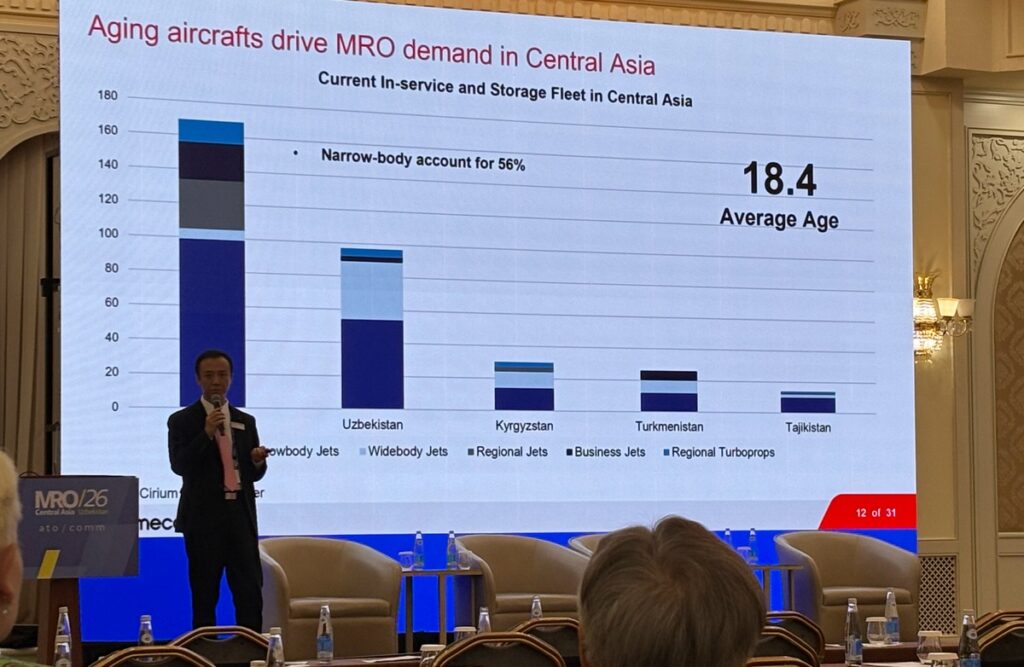

With an average fleet age of 18.4 years—well above the global norm—Central Asia’s aviation sector is facing a structural maintenance challenge that will shape the region’s operational future.
This reality took center stage at the MRO Central Asia 2026 conference and exhibition, held in March in Tashkent, Uzbekistan. Speaking at the event, Li Ji, General Manager of Sales and Marketing at Ameco (Aircraft Maintenance and Engineering Corporation, China), detailed how persistent global supply chain disruptions and a worldwide backlog of more than 17,000 undelivered commercial aircraft are forcing regional carriers to extend the service lives of aging jets far beyond original planning horizons.
The consequences for the region are clear: soaring maintenance costs, surging demand for sophisticated life-extension services, and an urgent need for MRO partners with deep expertise in mature fleet management.
FLEET AGE SURPASSING GLOBAL AVERAGES
According to data presented by Ameco, the aging trend is acutely concentrated in Central Asia’s two largest markets. Kazakhstan and Uzbekistan together account for nearly 80% of the region’s total fleet, meaning the financial and operational pressures of maintaining an 18.4-year-old average fleet will fall heavily on these two nations.
STRUCTURAL CHALLENGES AND DELIVERY DELAYS
Li Ji explained that the regional situation is being severely exacerbated by macroeconomic manufacturer constraints. With global OEM backlogs exceeding 17,000 units, airlines cannot refresh their fleets at standard intervals. Instead, operators are locked into running older, less fuel-efficient aircraft for extended periods, driving up both daily line maintenance needs and long-term heavy checks across the industry.
RISING DEMAND FOR LIFE-EXTENSION SERVICES
This prolonged service life is generating a surge in demand for specialized technical support. Li Ji noted that the current environment will continue to “generate substantial demands on MRO and life-extension services” as carriers strive to maintain safety margins, dispatch reliability, and operational efficiency despite aging hardware.
AMECO’S STRATEGIC ROLE
As a prominent joint venture between Air China and Lufthansa, and one of Asia’s largest MRO providers, Ameco is positioning itself as a strategic technical partner to address these regional pain points. Leveraging extensive experience in full life-cycle maintenance—including aircraft overhaul, engine repairs, and advanced digital troubleshooting tools—the company aims to support Central Asian airlines as they navigate these structural industry headwinds.
LOOKING AHEAD
The challenge of managing mature fleets in Kazakhstan, Uzbekistan, and the wider region will remain a dominant industry theme over the next 12 months. Long-term aircraft life-cycle strategies and advanced life-extension technologies are slated for in-depth review by global technical specialists at MRO Central Asia Kazakhstan and Aeroengines Kazakhstan in Astana this October, followed by MRO Central Asia Uzbekistan in Tashkent in 2027.
Don't miss our articles — subscribe
Key commercial aviation news from Central Asia and the South Caucasus — once a week, in your inbox.
Editor’s Choice
-
MRO Central Asia event in Astana highlights regional maintenance demand
AirlinesAirportsCargoMRO -
IATA Roundtable: Turning global cargo best practices into regional success
AirlinesAirportsCargoNews -
Tashkent to host 7th Central Asia Aviation Summit amid growth in Uzbekistan's air transport
AirlinesAirportsNews -
Aviation professionals gather in Astana for successful Central Asia Aviation Summit
AirlinesAirportsNews
Editor’s Choice
-
MRO Central Asia event in Astana highlights regional maintenance demand
AirlinesAirportsCargoMRO -
IATA Roundtable: Turning global cargo best practices into regional success
AirlinesAirportsCargoNews -
Tashkent to host 7th Central Asia Aviation Summit amid growth in Uzbekistan's air transport
AirlinesAirportsNews -
Aviation professionals gather in Astana for successful Central Asia Aviation Summit
AirlinesAirportsNews