
IATA: Central Asia is transitioning into an intercontinental air bridge
Since 2019, air cargo volumes in this region have more than doubled
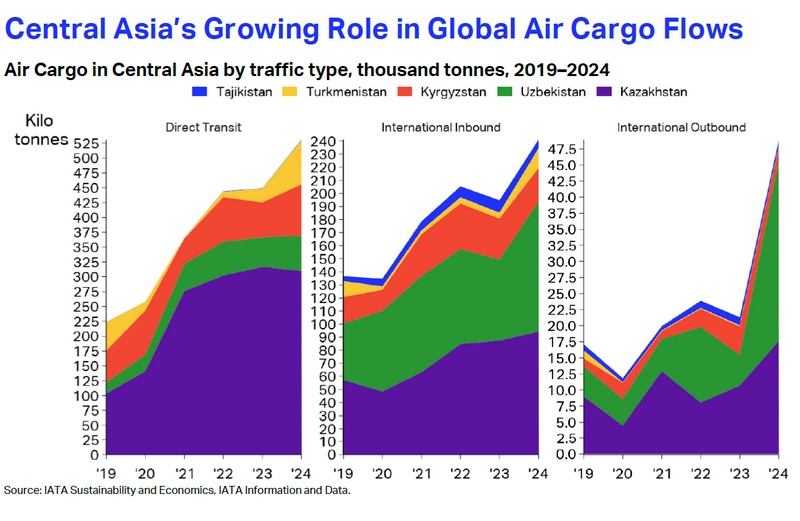

Central Asia is transitioning into an intercontinental air bridge: since 2019, air cargo volumes in this region have more than doubled, said an analytical report released by the International Air Transport Association (IATA) at the end of June.
Relative to the world’s leading air cargo hubs, Central Asia’s scale rose from just under one tenth of Hong Kong’s throughput to nearly one fifth, and from less than one fifth to more than two fifths of Frankfurt’s volumes.
Much of this expansion stemmed from direct transit with a technical stop at one of the region’s airports. The share of such movements surged from 59% to around 65% of the total air cargo in the region. International inbound and outbound cargo flows also increased, although inbound flows (imports) remain substantially larger.
Kazakhstan remains the primary gateway of the region, having increased its air cargo volumes by 149% between 2019 and 2024. Uzbekistan was the fastest-growing market over these years, expanding by 182% and overtaking Kyrgyzstan in terms of volume thanks to helpful infrastructure investments.
In 2024, outbound cargo volumes rose sharply. This suggests that the region is evolving beyond simple technical stopovers toward more active logistics connections and consolidation functions linking Europe and China.
Central Asia’s rise highlights how airspace constraints and the resulting network optimisation are redistributing traffic toward new intermediary corridors between Europe and Asia via this region, IATA noted.
Don't miss our articles — subscribe
Key commercial aviation news from Central Asia and the South Caucasus — once a week, in your inbox.
Editor’s Choice
-
Seven more Central Asian airlines plan to undergo IOSA safety audit
AirlinesNews -
IATA Roundtable: Turning global cargo best practices into regional success
AirlinesAirportsCargoNews -
Uzbekistan boosts air cargo traffic by 33%
CargoNews -
LCC FlyArystan Joins the IATA IOSA Registry
AirlinesMRONews
Editor’s Choice
-
Seven more Central Asian airlines plan to undergo IOSA safety audit
AirlinesNews -
IATA Roundtable: Turning global cargo best practices into regional success
AirlinesAirportsCargoNews -
Uzbekistan boosts air cargo traffic by 33%
CargoNews -
LCC FlyArystan Joins the IATA IOSA Registry
AirlinesMRONews