
Central Asia/Caspian/Caucasus region may temporarily become a new transit hub between Europe and Asia – Argus
Middle East crisis could redirect global passenger flows
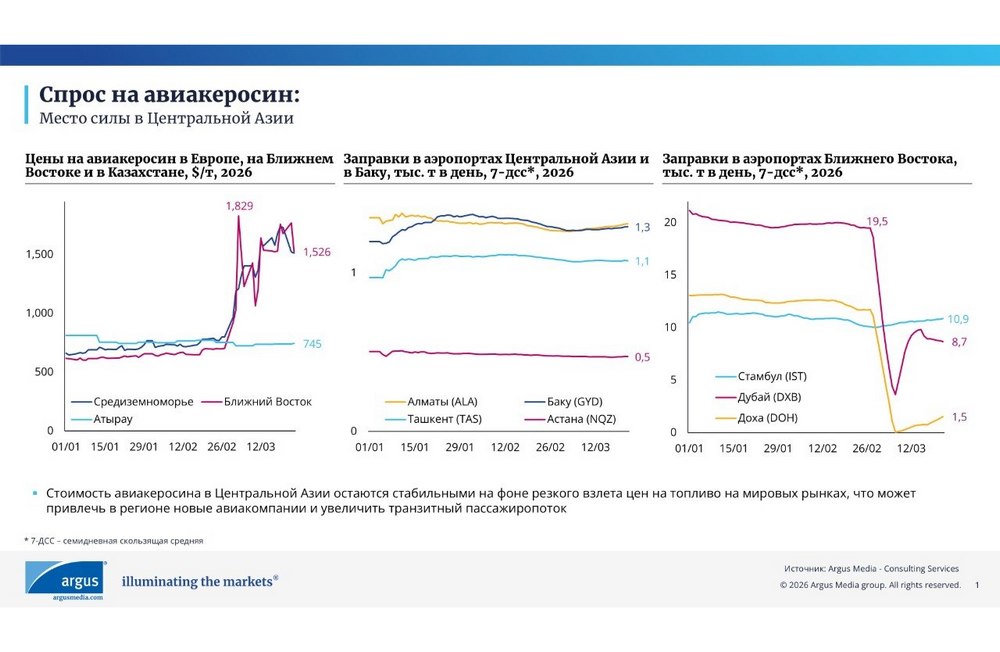

Military conflict in the Middle East and the resulting jet fuel shock are reshaping global passenger flows, potentially allowing Central Asia/Caspian/Caucasus region to temporarily emerge as a transit bridge between Europe and Asia. This view was expressed by Sergey Agibalov, CIS Consulting Director at Argus, an independent provider of global energy and commodity market intelligence.
“The global jet fuel market has been among the hardest hit by the conflict in the Middle East,”
The crisis has led to a sharp drop in passenger traffic at the region’s key hub airports—most notably Dubai International Airport and Hamad International Airport, both traditionally ranked among the world’s leading international gateways.
In 2025, DXB handled 93.5 million passengers with over 1,000 flights per day. However, as Agibalov noted, “on March 1, everything came to a standstill—the airport did not receive a single aircraft.” Operations partially resumed on March 2, but current capacity stands at around 40% of pre-conflict levels. Similar trends are observed at Abu Dhabi International Airport, Hamad International Airport and King Khalid International Airport in Riyadh.
Geopolitical risks are already reshaping transit patterns. Traditional connections via Middle Eastern hubs are becoming less attractive, with demand shifting toward alternative routings via Addis Ababa (the home base of Ethiopian Airlines), Istanbul (hub of Turkish Airlines), as well as airports in Central Asia and the South Caucasus.
Airports in Central Asia and the South Caucasus are becoming attractive not only to passengers but to airlines as well. The fuel factor is adding further pressure on airline decision-making. “The decline in Middle Eastern jet fuel exports due to the effective closure of the strait of Hormuz has driven a sharp increase in prices,” he said. According to Argus data, jet fuel prices in Europe and the Asia-Pacific reached $200–230 per barrel ($1,600–1,800 per tonne) last week, forcing airlines to adjust networks and optimize frequencies, as operations become economically challenging even when fuel is available.
Against this backdrop, Central Asia stands out as a zone of relative price and geopolitical stability. “This week, refineries in Kazakhstan were selling jet fuel at $734–777 per tonne, less than half of the spot prices in Europe and Asia-Pacific,” Agibalov noted. He added that the market is already responding, with transit traffic increasing through Heydar Aliyev International Airport in Baku (Azerbaijan).
“Favorable geography and lower jet fuel prices at airports in Almaty, Astana and Baku could help the region emerge as a new transit hub between Europe and Asia—at least temporarily,”
In his view, the current price disparity also clearly demonstrates the advantages of formula-based pricing for jet fuel suppliers.
Don't miss our articles — subscribe
Key commercial aviation news from Central Asia and the South Caucasus — once a week, in your inbox.
Editor’s Choice
-
Flight frequencies between Kazakhstan and Azerbaijan to reach 40 weekly
AirlinesAirportsNews -
Azerbaijan Airlines’ Central Asia passenger traffic climbs 35%
AirlinesAirportsNews -
LCC Wizz expands Baku European network with new Bratislava service
AirlinesAirportsNews -
Azerbaijan-Pakistan air connectivity expands as third carrier enters market
AirlinesAirportsNews
Editor’s Choice
-
Flight frequencies between Kazakhstan and Azerbaijan to reach 40 weekly
AirlinesAirportsNews -
Azerbaijan Airlines’ Central Asia passenger traffic climbs 35%
AirlinesAirportsNews -
LCC Wizz expands Baku European network with new Bratislava service
AirlinesAirportsNews -
Azerbaijan-Pakistan air connectivity expands as third carrier enters market
AirlinesAirportsNews