
Air Astana pivots route network eastward amid Eurasian conflicts
Military conflicts in Ukraine and the Middle East drive Kazakhstan’s largest carrier to redeploy capacity toward safer Asian markets
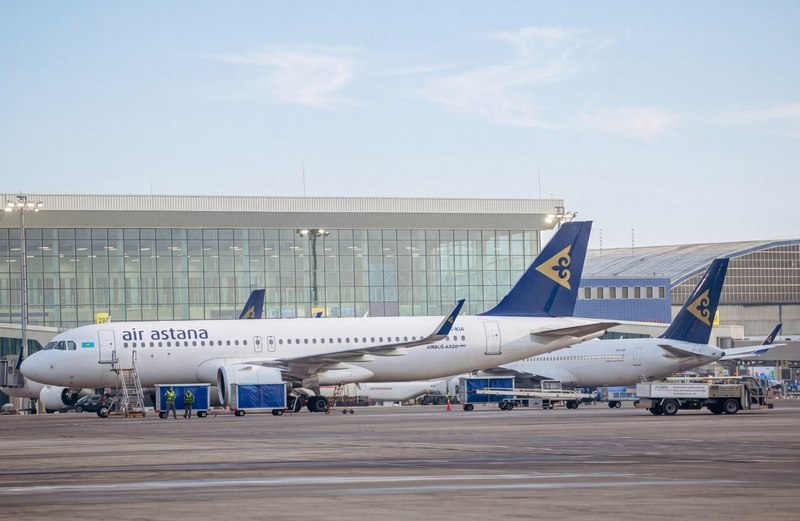

Military conflicts across the Eurasian continent have forced the Air Astana Group to reorient its capacity toward safe Asian destinations, Kazakhstan’s largest carrier announced today during a presentation of its first-half financial and operational results. The war in Iran has contributed to a decline in traffic to the Middle East, while the conflict in Ukraine has rendered many European routes unprofitable and indefinitely postponed the launch of flights to the United States.
China has emerged as the primary focus of expansion, with capacity surging by 81% in the second quarter and 93% overall compared to the same periods in 2025. Capacity will reach 51 weekly flights across nine routes by the end of the year, noted Air Astana CEO Ibrahim Canliel.
Over the past six months, the group has increased frequencies on existing routes to China and launched several new services. Air Astana commenced flights from Almaty to Shanghai and from Astana to Guangzhou, while its low-cost subsidiary, FlyArystan, entered the Aktau–Urumqi, Almaty–Xi’an, and Almaty–Chongqing markets.
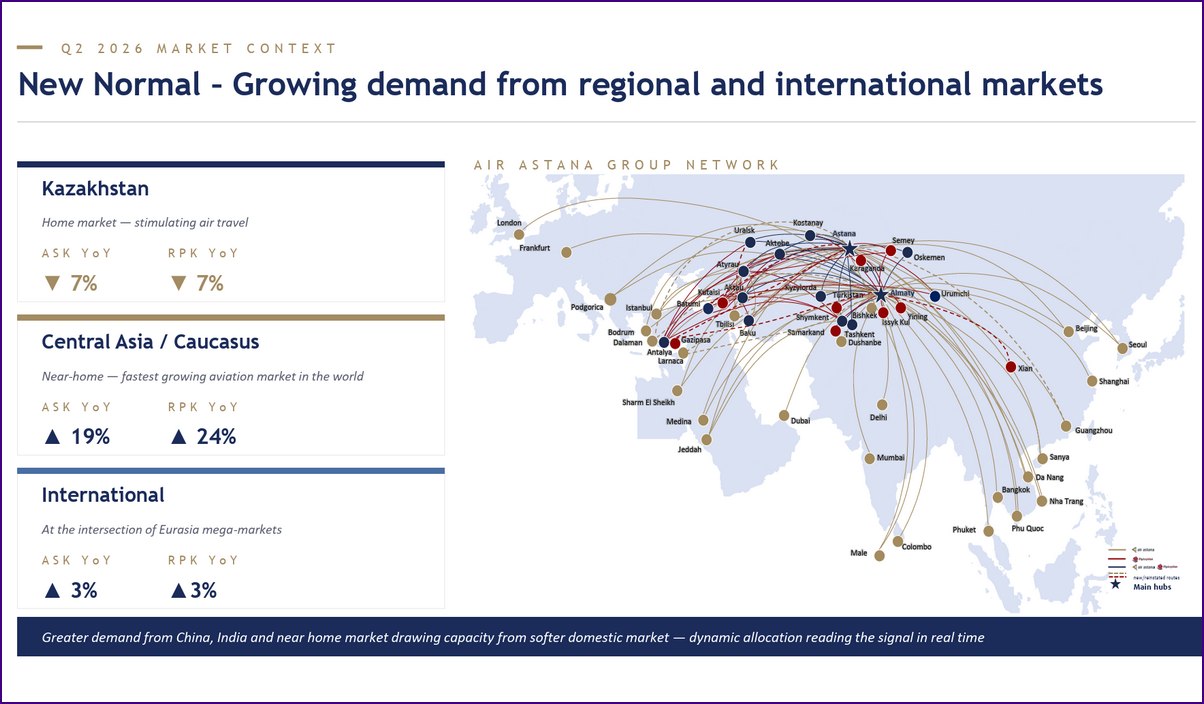
Infographics: Air Astana
In addition, capacity to India expanded significantly—up by 91% in the second quarter and 41% for the half-year. Air Astana increased its Almaty–Delhi frequency to twice daily while maintaining three weekly flights to Mumbai.
Capacity to Southeast Asia and Central Asia also grew by more than 10%.
Conversely, capacity growth on European routes remained minimal during the first half of the year, dropped by 12% on Turkey routes, and fell by 35% to the Middle East. According to Canliel, the necessity of circumnavigating Russian airspace has made flights on many European routes unprofitable for the carrier. Air Astana does not plan to resume routes over its northern neighbor as long as risks persist regarding aircraft diversion and interactions with sanctioned suppliers, he explained.
Furthermore, the timeline for obtaining regulatory approval to launch flights from Kazakhstan to the U.S. remains uncertain, Air Astana confirmed to CentralAsia+Aero. The airline had intended to open the route with new long-haul Boeing 787-9 airliners. The first two aircraft of the type are scheduled to join its fleet this year, with a third arriving in 2027. As Air Astana has previously acknowledged, non-stop flights to the U.S. using these airliners are unfeasible without overflying Russia.
The group’s summer schedule this year features approximately 330 international weekly flights—including 102 across Central Asia and the Caucasus—alongside more than 500 domestic weekly flights within Kazakhstan. For the first half of the year, the group’s total traffic declined by 2.4% to 4.39 million passengers.
Don't miss our articles — subscribe
Key commercial aviation news from Central Asia and the South Caucasus — once a week, in your inbox.
Editor’s Choice
-
Air Astana incurs H1 loss as passenger volumes soften
AirlinesEditor's ChoiceNews -
Air Astana finalizes order for 25 Airbus A320neo family aircraft
AirlinesEditor's ChoiceNews -
Air Astana Group extends Dubai suspension through end of summer schedule
AirlinesNews -
Air Astana increases transit traffic by 65%, but sees 3% dip in total passengers
AirlinesNews
Editor’s Choice
-
Air Astana incurs H1 loss as passenger volumes soften
AirlinesEditor's ChoiceNews -
Air Astana finalizes order for 25 Airbus A320neo family aircraft
AirlinesEditor's ChoiceNews -
Air Astana Group extends Dubai suspension through end of summer schedule
AirlinesNews -
Air Astana increases transit traffic by 65%, but sees 3% dip in total passengers
AirlinesNews