
Air Astana increases transit traffic by 65%, but sees 3% dip in total passengers
Due to the conflict in the Gulf, the group has redistributed capacity in favor of flights to Europe and China
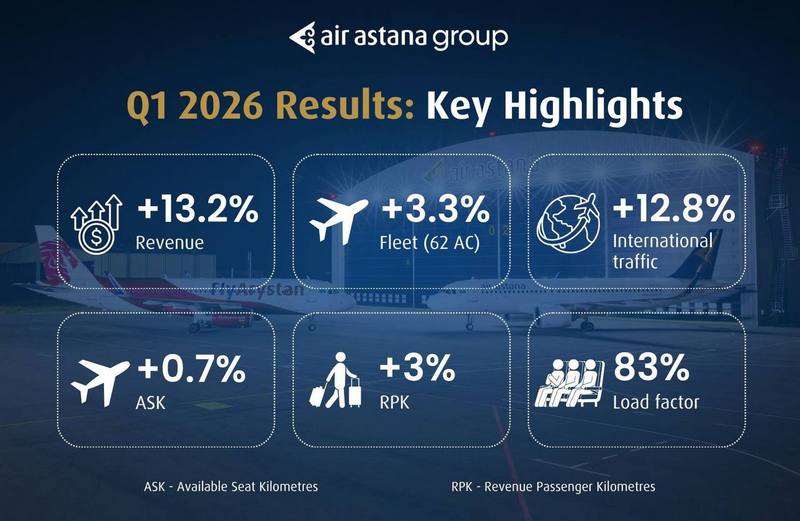

In the first quarter of 2026, Air Astana increased its international transit passenger traffic by 65% compared to the same period last year. This growth was driven by a redistribution of capacity following the closure of airspace in Persian Gulf countries at the end of February, according to Ibrahim Canliel, recently appointed CEO of the Kazakh airline group.
Following the suspension of flights to Doha, Dubai, Jeddah, and Medina, capacity on Middle Eastern routes was reduced by 51% relative to the original plan. Capacity on flights to Turkey was also decreased.
Conversely, the number of weekly flights on Western routes increased: London by two flights, Frankfurt by four, and Istanbul by six. On Eastern routes, growth included one additional flight each to Guangzhou, Sanya, and Seoul, five to Urumqi, and seven to Delhi. More spacious aircraft were also deployed on the Delhi route.
In March 2026, Air Astana launched three weekly flights between Almaty and Shanghai. The launch of Shanghai services expanded the group’s presence in China to six destinations and increased total capacity between Kazakhstan and China to 23 flights per week, up from 11 flights a year earlier. Currently, 15% of the group’s capacity is allocated to Chinese routes, triple the amount prior to the Persian Gulf conflict. By the end of June, the group plans to increase the weekly frequency of flights to China for its two airlines, Air Astana and LCC FlyArystan, to approximately 50.
Tourist traffic was redirected from the Persian Gulf to Southeast Asia: Bangkok, Male, Phu Quoc, and Phuket. ” We materially increased frequencies to these existing destinations and upgauged the latter two to larger 767 aircraft,” the airline said in the statement.
Air Astana managed to increase revenue by 13.2% to $331 million. However, due to rising costs, the group’s net loss for the quarter tripled to $21.1 million. The group cited higher expenditures on personnel, aircraft, maintenance, and transportation-related costs as the reasons for the increased losses.
Don't miss our articles — subscribe
Key commercial aviation news from Central Asia and the South Caucasus — once a week, in your inbox.
Editor’s Choice
-
Air Astana Group extends Dubai suspension through end of summer schedule
AirlinesNews -
Air Astana incurs H1 loss as passenger volumes soften
AirlinesEditor's ChoiceNews -
Air Astana pivots route network eastward amid Eurasian conflicts
AirlinesEditor's ChoiceNews -
Air Astana Group commissions second full flight simulator
AirlinesNews
Editor’s Choice
-
Air Astana Group extends Dubai suspension through end of summer schedule
AirlinesNews -
Air Astana incurs H1 loss as passenger volumes soften
AirlinesEditor's ChoiceNews -
Air Astana pivots route network eastward amid Eurasian conflicts
AirlinesEditor's ChoiceNews -
Air Astana Group commissions second full flight simulator
AirlinesNews