
Kazakhstan boosts cargo aircraft refueling amid global jet fuel shortage
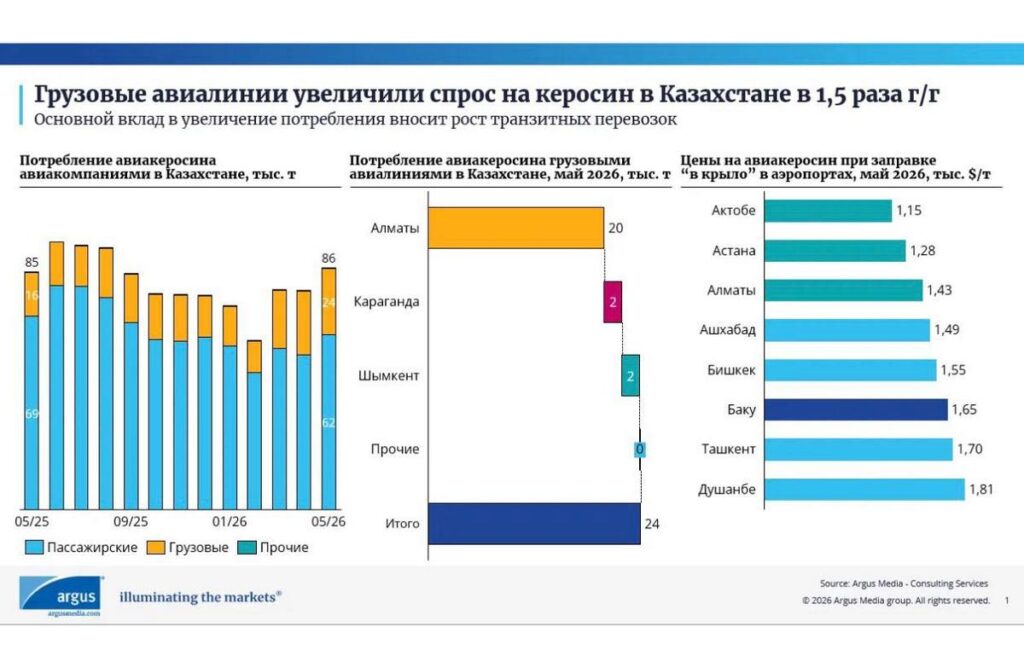
Jet fuel consumption on cargo flights from Kazakhstan rose 1.5 times in May — Argus

The geopolitical conflict in the Middle East, now in its fourth month, along with the resulting supply chain disruptions, is pushing international cargo carriers to optimize their route networks in search of stable and cost-effective regions for tankering.
In this context, leveraging competitive kerosene pricing, Kazakhstan’s Astana could emerge as one of Eurasia’s aviation hubs, according to Sergey Agibalov, CIS Consulting Director at Argus, an independent provider of global energy and commodity market intelligence.
Argus data shows that in May, jet fuel consumption on cargo flights from Kazakhstani airports surged 1.5‑fold to an all‑time high of 23,700 tons. This spike in the cargo segment offset a 10% year‑on‑year decline in demand from passenger carriers over the same month.
A sign of Kazakhstan’s growing transit potential was the launch, in June, of transit cargo flights by Luxembourg’s Cargolux and China’s Sichuan Airlines, with a technical stop at Astana airport.
“Amid widening restrictions and conflicts, Astana could become one of Eurasia’s main aviation hubs, initially capturing cargo flows from Middle Eastern airports and later passenger transit,” says Sergey Agibalov. “One key success factor could be competitive formula‑based kerosene pricing.”
The Middle East crisis has exposed the structural vulnerability of the global jet fuel market, which has proven less resilient to logistics shocks than other refining segments. According to Argus, by late February 2026, U.S. commercial jet fuel inventories had fallen to 27 days of consumption (compared to 32 days for gasoline). An even tighter situation emerged in the UK (24 days) and Japan, where reserves stood at just 10 days of autonomous operation.
Against a backdrop of local shortages and record-high exchange prices, the ability of Kazakhstani airports to secure physical fuel volumes and offer predictable pricing is becoming a competitive advantage on Eurasia’s aviation map.
Don't miss our articles — subscribe
Key commercial aviation news from Central Asia and the South Caucasus — once a week, in your inbox.

Editor’s Choice
-
Cathay Cargo adds Astana stop to Asia–Europe network
AirlinesAirportsCargoNews -
Hong Kong's Cathay Pacific to launch both passenger and cargo flights to Kazakhstan
AirlinesAirportsCargoNews -
New transit cargo carrier arrives at Astana Airport
AirlinesAirportsCargoNews -
Cargolux Airlines to return to Astana
AirlinesAirportsCargoNews
Editor’s Choice
-
Cathay Cargo adds Astana stop to Asia–Europe network
AirlinesAirportsCargoNews -
Hong Kong's Cathay Pacific to launch both passenger and cargo flights to Kazakhstan
AirlinesAirportsCargoNews -
New transit cargo carrier arrives at Astana Airport
AirlinesAirportsCargoNews -
Cargolux Airlines to return to Astana
AirlinesAirportsCargoNews